Surrey County Council uses our ‘Thriving’ research to shape the future of their residential and nursing care
We are pleased to share a case study of how our ‘Thriving in Residential Care’ research has been adopted by Surrey County Council, to shape the future of their residential and nursing care provision.
The research is supporting the quality of life of hundreds of people in care homes, especially those with complex care needs.
 Background
Surrey has a growing older population. More people are receiving care and support in their own homes for longer periods, which means that those moving into care homes often have more complex mental and physical health and care needs.
As a result, Surrey set out to reassess their care home provision to ensure their future services would meet people’s needs.
In early 2025, Surrey began a Resident Co-Design and Engagement project to shape the future of their residential and nursing care, led by Commissioning Manager Sarah Rajendram.
To develop this work, Surrey County Council used our ‘Six Dimensions of Thriving’ research framework which highlights the key ways that older people can thrive in a care home – through relationships, activity, inclusion, dignity, security and health.
Surrey wanted to understand the experiences of people in care homes and what good care means to them, while also exploring whether the Thriving research remains relevant for care homes that specialise in supporting people with complex care needs.
Listening first
Through Surrey’s engagement work, over 90 people shared their lived experiences and ideas for what it means to thrive in a care home. Participants represented a diverse range of voices, primarily older people aged 65 and over, as well as family members, care arrangers, care home managers, and front-line care team members.
Between January and April 2025, Surrey County Council gathered insights through pop-up sessions at eight community events, in-depth one-to-one conversations at eight care homes, and two online workshops with local people. Five of the eight care homes involved were chosen specifically for their positive reputation in supporting people with complex care needs, to ensure the work spoke directly to this priority group.
Responses were coded and analysed to identify recurring themes, which were then considered in relation to the ‘Six Dimensions of Thriving’ that we identified in our original Thriving research.
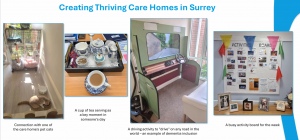
What people said
Surrey County Council’s findings mapped consistently to all six dimensions of our ‘Thriving’ framework, revealing that our research translates consistently to other places, and is also relevant for care homes specialising in supporting people with complex care needs.
Thrive Relationally
People who participated in Surrey’s engagement project spoke about wanting to be known and valued for who they are, and not defined by age or need. For those living with dementia, small gestures were seen to make a real difference:
“It’s so important, to be valued for who you are.” – Older person
“Living with dementia can be scary. I see staff putting a hand out, and residents will hold that hand.” – Surrey Home Manager
The importance of friendships between people living in the same home came up often too. These were built on shared interests as much as shared circumstances. This draws a direct parallel to our research theme of ‘Thrive Relationally’, which focuses on building and maintaining connections.
“Get on better with some than others. That’s life. That chap who has just come in, we have a shared love of music. We have a bit of banter, back and forth.” – Person receiving care
Thrive Actively
Surrey’s work showed that purposeful activity gives people’s days shape and meaning, whether through music, movement, baking or simply the freedom to choose their level of involvement in activities. This corresponds directly to our Thrive Actively theme.
“Play is very important – it gives meaning to life.” – Older person
The whole point of doing a baking activity is for the residents to do it themselves and eat what they’ve made from scratch.” – Surrey Home Manager
Thrive Inclusively
Inclusive thriving meant understanding and celebrating each person’s unique identity – their culture, faith, history – as part of everyday life in the home, from shared meals to music. This likewise tallies to the theme of ‘Thrive Inclusively’, which highlights the importance of care services being inclusive environments where diversity is valued and respected.
“A lady upstairs is a Sikh and [there was] a gentleman who was a Muslim. And we play the music that they can relate to.” – Surrey Home Manager
Inclusion also extended to those living with dementia, who were encouraged to attend social activities:
“All residents on the complex unit are often together in the lounge area in the day, and the carers sit in with them to make sure they are safe. It’s hard for Dad to be included as he struggles verbally now, but he is content.” – Family Member
Thrive Securely
People shared that, for them, security depended on consistency and a calm environment. As one person living in a care home in Surrey put it:
“It’s just like being at home, in lots of ways.”
For complex care specifically, homes focused on adapting around the person’s needs. As one home manager shared:
“We evolve with them, rather than them fitting into our boxes.”
This once again tallies with our original research, where Thriving Securely meant reassurance that people were safe, comfortable and able to access support when they needed.
Thrive with Dignity
The theme of Thrive with Dignity focuses on receiving care that respects your choices, comfort and independence.
In Surrey, people said that they thrived when they were seen, treated, and respected as people, rather than as cases to be managed. Dignity materialised in daily choices, and people receiving care and families alike pointed to the quality of the care teams as the thing that mattered most of all:
“You can go down for breakfast in the mornings. They come and ask you what you want [to eat] for today, tomorrow and whatever. You have a choice.” – Person receiving care
“As long as they’ve got staff that genuinely care and look after them, that’s the best thing you can ask for.” – Family Member
Thrive Healthily
Both in Surrey and in our original research, health and wellbeing were closely tied to good nutrition, integrated healthcare and access to the outdoors.
For people receiving care, having a GP who knew them and nurses on hand onsite brought them a real peace of mind.
“The grounds surrounding the building are beautiful and my view from my room is lovely, I can watch the birds and wildlife and will go outside once the weather gets warmer too.” – Person receiving care
“If you have a heart attack or something, there’s someone here all the time, which at home, you had to look after yourself, there was no one on the premises with medical expertise.” – Person receiving care
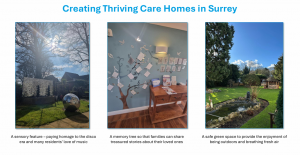
Future development
Surrey has already begun putting these insights into practice.
The team shared in a recent update:
“We recently extended a contract with a strategic provider, and in doing so were able to utilise the newly developed specification [which] … incorporates the principles and learning from the Thriving research, ensuring that the work is already influencing service delivery.”
We’re proud to see our research making a difference to how care services are designed and delivered, and we look forward to following Surrey’s continued progress in helping older people to thrive!
And if you are interested in exploring how our Thriving research could support care provision in your area, please reach out to us: