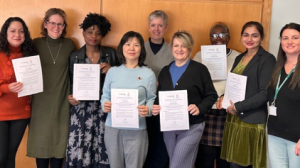
High Five Surrey! Celebrating our 4th and 5th Surrey PSDP Cohorts
We’re delighted that, over the last two years, 43 care leaders from a range of Surrey care services have completed a My Home Life England Professional Support and Development Programme (PSDP)!
Surrey County Council commissioned 5 cohorts of our PSDP, delivered from 2024-2026 to further support and develop social care staff.
The PSDP provided care leaders with a practical, evidence-based leadership toolkit to strengthen everyday practice in their care settings, utilising relationship-centred frameworks and an ‘appreciative’ strengths-based approach to strengthen leadership capability and resilience, and improve culture, psychological safety and communication.
The programmes combined four workshops and six Action Learning Sets using the My Home Life Frameworks. The final workshop was a bespoke ‘Complex Care Needs’ workshop – a challenging area identified by participants. Learnings from this workshop have contributed to a paper exploring the challenges and opportunities for supporting individuals with complex needs, from a care provider’s perspective.
Some of the challenges the care leaders shared:
Before starting their programme, participants shared a range of challenges they face across their care settings, including operational pressures that limited the opportunity for development, the demands of managing complex situations, having difficult conversations and issues surrounding wider system working, particularly hospital care. The leaders described needing to embed clear systems, processes and boundaries while sustaining their own resilience and reflective practice.
One manager shared: “I tend to be quite a nurturing person but I take on too much myself.”
The Key Outcomes
Across the five cohorts, leaders consistently reported a rich set of personal outcomes, with a ripple effect on their teams and organisations. Leaders typically reported moving from excessive stress to more confident, reflective, and relational leadership. This shift leads to better team cultures, improved care quality, and enhanced wellbeing for themselves and their staff.
Our Endings Surveys discovered that 100% of surveyed participants felt their understanding of how to improve the culture of care had improved, alongside their engagement with staff.
Additionally, across the 5 cohorts, 89-100% felt their quality of management and leadership had improved, demonstrating the programme’s effectiveness in embedding relationship-centred leadership.
Outcomes included:
- Leadership Capability: Stronger confidence, a greater sense of professional identity, clearer boundaries and understanding the culture of change
“I am more confident and reflective – able to pause, plan with others, and lead with clearer boundaries.”
- Personal Wellbeing: Reduced stress, greater job satisfaction and a better work-life balance
“I now feel more confident under pressure – I am better able to manage stressful tasks and stay resilient when facing negativity.”
- Team Culture and Engagement: Managers described stronger, more collaborative and reflective teams, with higher morale, psychologically safe environments, and better listening.
“We have a stronger team culture now – my team are more engaged, collaborative and empowered, supported by appreciative practice, active listening and effective delegation.”
- Quality of Care & Quality of Life for Service Users: Participants felt there was an improved quality of practice, leading to better interactions with residents and relatives and a stronger sense of community.
“I am able to be more present and person‑centred-spending time with residents, listening to their wishes, and empowering my staff to engage.”
- Organisational Outcomes: Staff noted positive or stable organisational indicators such as staff retention, reduced absence and ability to meet CQC requirements.
“Improved CQC readiness, with more stable staffing—retention and sickness levels improved or held steady—and renewed enthusiasm for care.”
Participants consistently praised the facilitation, peer support and safe space created by the programme. One shared: “It was a safe, supportive space with strong facilitation – this peer learning helps leaders reflect, learn and gain new perspectives.”
Another added: “Using the appreciative inquiry approach with staff has really worked. The culture and working environment have improved.”

Looking Ahead
Care leaders are facing many challenges in their role, but as a result of the programme, leaders were able to share these challenges, feel supported, and learn a variety of tools, skills, and strategies. Building on positive practice led to strengthened leadership, improved team culture, healthier working practises and enhanced care quality.
Congratulations to all of our Surrey cohorts! It has been brilliant to work in Surrey over the past two years, and we are proud to have empowered more care leaders with the skills, mindset and resilience to lead their teams and create positive cultures in their services.
Catch up on Surrey Cohort 3 completion
Catch up on Surrey Cohort 2 completion
Catch up on Surrey Cohort 1 completion