Strengthening Personal Resilience for Care Leaders Across Liverpool
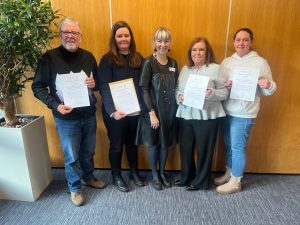
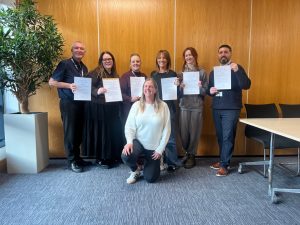
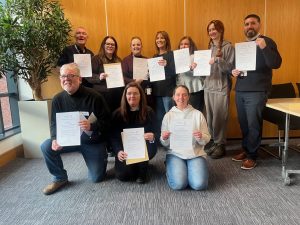 Earlier this year, we celebrated two inspiring cohorts, who completed a Professional Support and Development Programme (PDSP) in Liverpool.
A total of 14 care leaders completed, including care home managers, deputy managers, services managers and care coordinators across different providers and areas of social care.
Funded by Liverpool County Council, the programme supported care leaders to share the challenges they face and through group discussions, and they explored new skills, strategies and tools to help overcome these obstacles. The programme combined themed workshops and eight Action Learning sessions, aiming to encourage long-term resilience, capacity, and skills development in care settings.
The participants worked closely together, and established a stronger peer support network, using tools such as Caring Conversations and our My Home Life England photocards to facilitate open discussions.
Some of the challenges the care leaders shared:
At the start of the programme, the leaders reported that they were facing challenges including: burnout, retention of care staff, patchy partnership working and approaches across the care system, and struggles with the pace of change.
What Impact did Care Leaders Experience?
Alongside improved leadership skills, 85% of surveyed participants also reported:
- an increase in their job satisfaction, team morale and in time they made to support staff.
- an improvement in the quality of interactions between their team and service users.
Theme of Personal Resilience
Personal resilience emerged as a key theme for all participants on the programme, and greater self-insight and development were among the most significant outcomes.
One leader described themselves as ‘close to burn out’ prior to the programme; another was determined to ‘not let down’ staff and those receiving care and support following a difficult management buy-out. There was a noticeable shift in work-life balance, with one manager describing how they used the tools and support from the group to start letting go of big to-do lists and prioritising their own health. Another recognised that their own physical and mental health was as important as that of those they were supporting.
‘‘I am more relaxed. I have started to acknowledge the strengths of my team so I can delegate and ultimately rely on them to make decisions without me. I have learnt to listen more and not just react to situations. Often my staff have the answer, so I don’t have to fix everything! I have even been on holiday without checking my phone!”
Impact of Action Learning Sessions
Care leaders participated in monthly action learning sessions, providing an opportunity to reflect on successes and challenges in their real-world care settings, to support and guide one another, and to continue to make meaningful change. We used these sessions to explore the prioritisation of workload. The cohorts found Action Learning Sets beneficial, sharing:
- “Having a safe space to off-load with no judgment has been comforting and refreshing.”
- “Isolation as a leader in the care sector is real. This group has helped me feel less alone.”
- “It’s nice to receive praise from the group for even the small things I achieve. As a manager, I often praise my staff but to be praised has been so nice!”
- “After the sessions I feel better, my focus can often change and I have more energy to go back to work.”
Other outcomes included:
- An increase in leadership skills and confidence: “The relationship circle exercise helped me to see the bigger picture. It helped me focus on the areas of the home/staff who needed more of my time and to let go of those who were performing well.”
- The importance of letting go and improved work life balance: “I have taken my first holiday without taking the work mobile with me and do you know what? Everything was fine without me!”
- Honest and inclusive conversations regarding neurodiversity: “Since being on this course I have spoken to my line manager about the challenges I have in relation to my Autism. This has meant we understand each other better, we have made some positive adjustments to my work, and this has improved my leadership.”
How MHLE Frameworks helped:
- Using Check-in Postcards: “My team now really enjoys the freedom to introduce new topics to our meeting, via the cards.”
- Improvements to relationships with other professionals and more confidence in having difficult conversations: “We are now working as a team and using caring conversations to support each other.”
- Using the Senses Framework: “This exercise helped me keep track on how I was coping as a manager, if the scores fell a bit I knew it was time to get some support and on the other hand, it helped me to reflect and celebrate my achievements.”
We are delighted that several leaders also secured promotions during the programme and forged new connections and relationships, supporting a stronger care network across Liverpool.
Facilitator’s Perspective
Alison Kilduff, said
“I was amazed at the dedication, talent and sheer will demonstrated by the leaders and managers, and was moved to see the growth of confidence and recognition of natural strengths and abilities throughout the programme. This was grounded in outstanding camaraderie and warmth amongst the group, which is a hallmark of Liverpool, but amplified by those who care for a living.”
Congratulations to all on your impressive and inspiring achievements!
Interested in knowing more about our programmes? Get in touch for a chat!
Contact us